
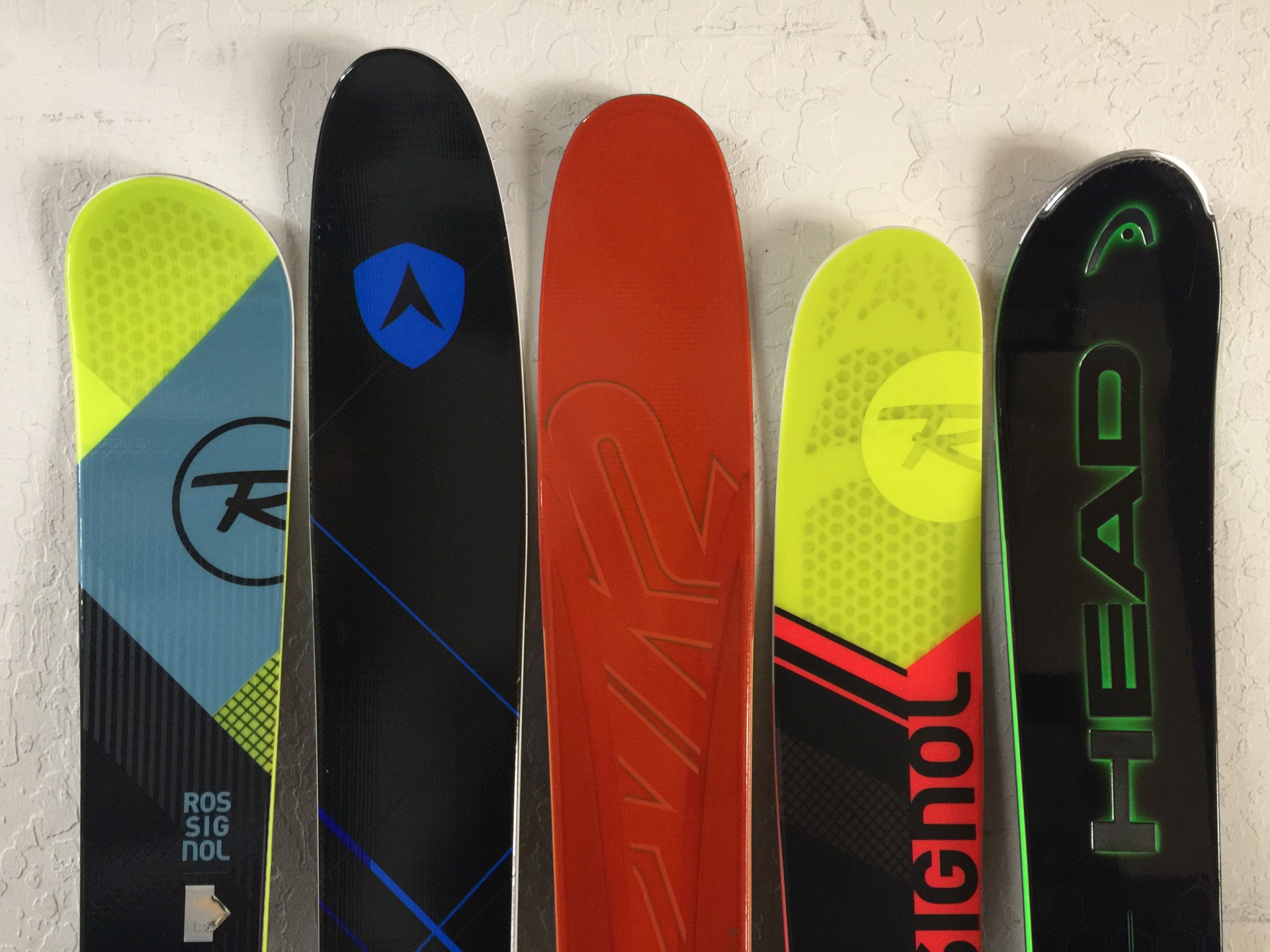
It seems like only yesterday, but it was in fact five seasons ago that Dynastar debuted its first Cham collection, in the process drawing attention to a feature that until then was found mostly on renegade, athlete-driven, freeride brands: the 5-point sidecut.
The five points that defined the original Cham sidecut were:
- width of the shovel
- widest point on the forebody
- thinnest point at the waist
- widest point on the tail
- width at the very end.
This reverie focuses on the first two points, which together define the shape of a tapered tip. There are two traits common to all: 1) the widest part of the shovel extends back towards the mid-point and 2) the forebody is inevitably rockered. It should be noted that were it not for the nearly universal application of rocker to modern skis, we would most likely have no such thing as tapered tips to talk about.
The season after the Chams appearance, brother brand Rossignol applied a 5-point sidecut to its 7 series of off-trail skis; the series’ star model, the Soul 7, soon shot to the very top of the sales charts. For the upcoming 2018 season, one of the most obvious changes to the next generation of Rossi 7’s is that the elongated tip is narrower, making the full-length, narrow-wide-narrow-wide-narrow measurements seem curvier than ever.
In the brief epoch between the first Cham 97 and the latest Soul 7, the tapered tip has become a staple of off-trail ski design. World conquest shouldn’t be this easy.
A selection of tip configurations, 3 tapered, 2 traditional.
The near universal adoption of the rockered/tapered tip shape is worth noting because, up until the arrival of rockered forebodies a few years earlier, ski makers were obsessed with carving, striving to maintain continuous ski/snow contact at all costs. The main point of 5-point sidecuts, on the other hand, is to reduce ski/snow contact, to essentially undo what ski designers had spent a generation trying to perfect.
Why seek to minimize the ski/snow connection just when it’s beginning? Because, unlike on prepared slopes, in off-trail skiing the tip can’t be trusted to set the agenda. A forebody that is over-eager to steer is as much of a struggle to control in crud as a ski that refuses to smear, two undesirable traits that are often packaged together.
Peaceful Co-Existence
While a tapered tip has become essential equipment on the vast majority of Powder skis, there are still a few examples of classic, widest-in-the-shovel, skinniest-at-the-waist and widest-at-the-very-end sidecuts among skis over 100mm underfoot. The top-of-mind example is the Head Monster 108, an off-trail footprint with a dab of tip rocker but otherwise built to hold an edge with pit-bull tenacity, end to end.
If this sounds as if Head needs to let go of its Old School mentality, be advised that a new generation of off-trail models called Kore provide as stark a contrast to the Monsters as one will find in the same category from the same supplier. Where Monsters have serious, wood-and-metal heft, the Kores use a featherweight recipe of Graphene, carbon, Koroyd and Karuba, an ultralight wood, to pare weight to a minimum. The Monsters disdain smearing as weakness; the Kores smear sideways as easily as tub margarine.
Another example of a wide ski with an on-trail sidecut is Rossi’s Experience 100 HD, with a continuous edge right up to the end of its see-through Air Tip. The Experience 100 HD headlines a series of Frontside skis, so it’s entirely appropriate that its shape maintains an on-trail orientation even though its girth is an open invitation to travel off trail.
While this little monograph puts a spotlight on forebody shape, please remember, Dear Readers, that a ski is an amalgam of all of its elements. No one characteristic determines all behaviors. Even skis from the same brand meant for the same purpose almost certainly won’t ski the same. One way in which they may differ is how the tip meets the snow. Just because almost all Big Mountain models use some form of tapered tip definitely doesn’t mean they’ll ski anything alike.
It just means that if you face-plant, your tips aren’t to blame.