
Suppose you’ve decided that this is the year you’re finally going to spring for new skis. Let’s add to this scenario the likelihood that you’d prefer to get a good deal on your prospective purchase. To help guide you through the thicket of decisions in front of you, let’s first get a big-picture look at what the U.S. market for men’s alpine skis looks like for the 2026 season.
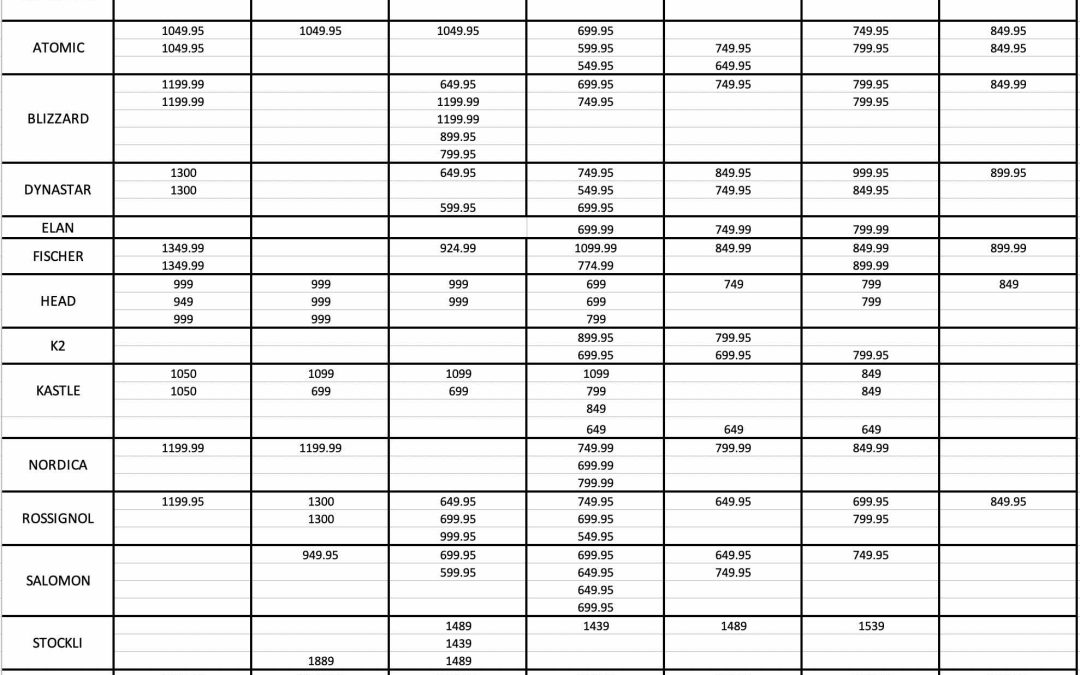
To get an overview of today’s ski-pricing panorama, I’ve sorted the current market by brand and genre, using category definitions that key off the waist width boundaries I established over a decade ago. I’ve replaced the model names with their respective Minimum Advertised Price (MAP) for easy comparison across brands. Let’s take a deep dive into the price structure of the market as a whole, beginning with the Non-FIS Race column.
Once upon a time, racing and recreational skiing were closely linked in terms of both product and culture, but that world has long since ceased to exist. Now alpine racing is a world unto itself, with little correlation to most of the rest of the ski world, and this unbridgeable divide carries over to the price grid. Most brands sell the race skis they allow the general public to buy at suggested retail, period. Any special pricing is restricted to programs that control what is sold to whom and at what price. In any case, no one in their right mind buys a race ski, FIS-sanctioned or not, based on price. As I said, it’s a totally different world.
The Technical genre is alive and well in Europe but dead as a doornail in the U.S. As with the NFR genre, prices are unflinchingly high. The only below-the-norm price that jumps off the page comes from Kästle, who concocted its new M9 series specifically as a low-cost alternative to its far pricier kin, the fabled MX series. At the other end of the pricing spectrum, Stöckli’s Laser SX is unabashedly well above the norm.
The Frontside market is by far the most diverse in every respect, serving every skier from never-evers to the technically flawless. Most Frontside models are system skis, meaning they come with their own binding, which usually is reflected in a $200 price bump over the same ski flat (i.e., no binding). There’s a fully populated netherworld of Frontside system skis made to hit commercially popular price points that aren’t on this grid, as all brands that engage in this segment follow similar pricing/performance guidelines.
As we move to the right side of the pricing matrix, we’re into product families with siblings in every price slot. In the All-Mountain genres, where most skis are sold in this country, two factors dominate the price segmentation picture: width – as a rule, wider skiers cost more – and the introduction of alternative model families to increase brand penetration of the most important – and profitable – categories. The customary rationale for two model families spread over four categories is that one will be biased towards mixed, off-trail conditions while the other will retain elite carving/groomed terrain attributes.
So, what does this price grid tell us about the market where you’re currently searching for your next ski? First of all, there’s no point in shopping for a new ski based on price. The prices for comparable skis are all virtually the same, close enough to qualify for price fixing, not that anyone in the current regulatory climate gives a hoot. Sure, there’s a $50 difference here and there, BUT DO NOT BASE ANY SKI (OR BOOT OR BINDING) BUYING DECISION ON A $50 DIFFERENCE. Considering how long you’re going to own your new skis, a $50 price difference doesn’t mean diddley.
If you were to compare this grid to a parallel exercise on last season’s MAP pricing, you’d find that even crippling tariffs didn’t move ski prices significantly upward. The facts are, both retailers and suppliers are trying hard to keep prices tethered to the same price points that have prevailed for over a decade. The principal force keeping a cap on retail pricing is fear of a consumer backlash that will signal a massive market retreat. While such concerns aren’t unfounded, the most price-sensitive participants have already been flushed out of what was once a middle-class sport. But most suppliers continue to act as though the skier population is shrinking, at a time when participation seems to be holding at or near all-time highs.
Allow me to hasten to point out that just because 10 companies all sell a ski intended to retail at, say, $799, that all such skis will perform equally well. There’s nothing preventing a brand from making a sub-standard product and slipping it into an inventory comprised mostly of better-made models. As costs increase, so will the temptation to skimp on construction in order to keep retail pricing in check. We may have reached the point where suppliers will face tough choices about whether to increase price, degrade quality or just drop a product from its catalog.
If not now, when?
With the notable exception of Stöckli, most skis in a given genre are priced within $50 of their competitors, at least on paper. This will be the status quo through the fall for all new skis, but the same rules don’t apply to carryover inventory. The fall season is one of the best times to shop for a discontinued or used ski because the seller is motivated to liquidate second-hand stock. The largest and most successful ski swaps in America do most of their business in October, so if you know what you’re looking for, it’s a great time to pounce on a deal.
There’s only one drawback to buying pre-season: you won’t be able to demo the ski before adopting it. This needn’t be a deal-breaker, but if you really want a new ski at the best price, you might as well wait until after the holidays. The best deal on a new ski won’t materialize until late February, when vendor rules on pricing policies lower the MAP price, which means you’ll have all of January and most of February to try every model on your hit list. This wait-to-buy mentality is right in line with current consumer tendencies to defer major purchases until the last minute. The longer one waits, the more the average sale price will decline until the season is over.
While the demo-before-you-buy program is recommended, there’s always the risk, however slight, that the model you finally fall for will be sold out. Given the perennially over-stocked position of the last few seasons, it might be hard to imagine a model selling to the wall, but the surpluses of the past are finally receding, and early indications are that retailers will be buying conservatively given an uncertain economic environment.
So, what did we learn from this exercise? Take-away number one has to be the market trend towards price parity within any given non-race category. Conclusion number two: the best time to buy a new ski is either early, when selection is at its peak, or late, when price competition among retail outlets intensifies. Your best shot at used gear or discontinued models occurs during the fall swap period, typically sometime in October. This may sound like a crazy way to operate, but it wouldn’t have evolved in this direction if the major brands didn’t want it that way. The U.S. ski market has been following this pattern of pricing parity and sell-through guidelines for over a decade. It’s unlikely to change in the foreseeable future.

Related Articles

In Memorium, Carl Ettlinger
Carl was a giant of a man whose outsized voice roiled every conversation like a burst dam and whose expansive vision reached across the mixed milieus of research, journalism, risk management and education. I knew him when he was at the peak of his powers, as he explained to me when I interviewed him for a “where are they now?” profile in Skiing History. He was able to conduct long-term research on injury patterns as well as analyze the particulars of the current binding market, turn around and package this knowledge into articles for Skiing and Skiing Trade News, followed up by a workshop tour that would bring enlightenment to the grassroots level. No one but Carl could have pulled this off, and Lord knows no one has had the requisite talent, energy and will power since.
But time and tide wait for no man, and Carl’s finely spun web of influence was eventually plucked apart. The loss of his pivotal positions in the press allowed him to slip from public view before we, the skiers of the world, realized we hadn’t taken the time to thank him.
We have the time to thank him now.
So thanks, Carl, for being first and foremost a teacher, for teaching is at the heart of the evangel’s mission.
Thanks for being so damn stubborn. Your insistence on improving skier safety wore through a wall of resistance as tough as Vermont marble.
Thanks for having a heart as big as that melon-sized head of yours. The fuel to your tireless mind was a caring heart that tried to embrace the world.
Thanks for all the stories once the Mount Gay flowed. Who knew we would have won the Vietnam War if only his superiors had listened? I can’t remember exactly how – he wasn’t the only one drinking Mount Gay – but I recall the light in his eyes as he relayed his twisted tales, taking us down successive rabbit-holes of digression that I lost track of at the seventh level.
That’s what I remember most vividly about my many interactions with Carl: his brain so teemed with thoughts he rushed to get them out in a verbal jailbreak that would travel around the cosmos until returning, many lost minutes later, to the subject that had inspired them. That was Carl: too many words for one sentence, too many tasks to tend to and all of it, every erg of his endless energy, devoted to a cause he never ceased to serve.
Fare thee well, Carl Ettlinger. The world misses you already for it will never see another quite like you, whose every moment seemed larger than life itself.
I raise my glass to you, old friend. Mount Gay, of course.
Jackson Hogen
June 23, 2020

Why This Buyer’s Guide?
Don’t read the 2021 Masterfit Buyer’s Guide in Partnership with Realskiers.com for its 62 ski reviews. I should know. I wrote or edited all of them.
Not that the ski reviews aren’t worth the read. But ski reviews on the web are as common as rice, while the Buyer’s Guide contains something no other publication, whether in digital, print or video format, can claim: the most respected, thorough and dependable boot reviews in the world.
This isn’t mere puffery. The Masterfit Boot Test is so well regarded by the supplier community that nearly every brand not only sends its following year’s line-up in four men’s sizes plus three for women, it also dispatches its top designers and/or product managers to a distant North American site for most of the test’s five-day duration.

The Ripple Effect
As I’ve observed in this space before, product managers spend most of their time in the future; the present for them is two years away for the rest of us. So when the coronavirus shut down the 19/20 ski season, it triggered an automatic response in the R&D lobes lodged deep in my noggin: what impact will this have two years down the road?
If I knew the answer to this question with any certainty, I should be running a hedge fund, not scribbling about skiing. But after checking with several of the bellwether players in U.S. market, I have some idea of what’s in store.
