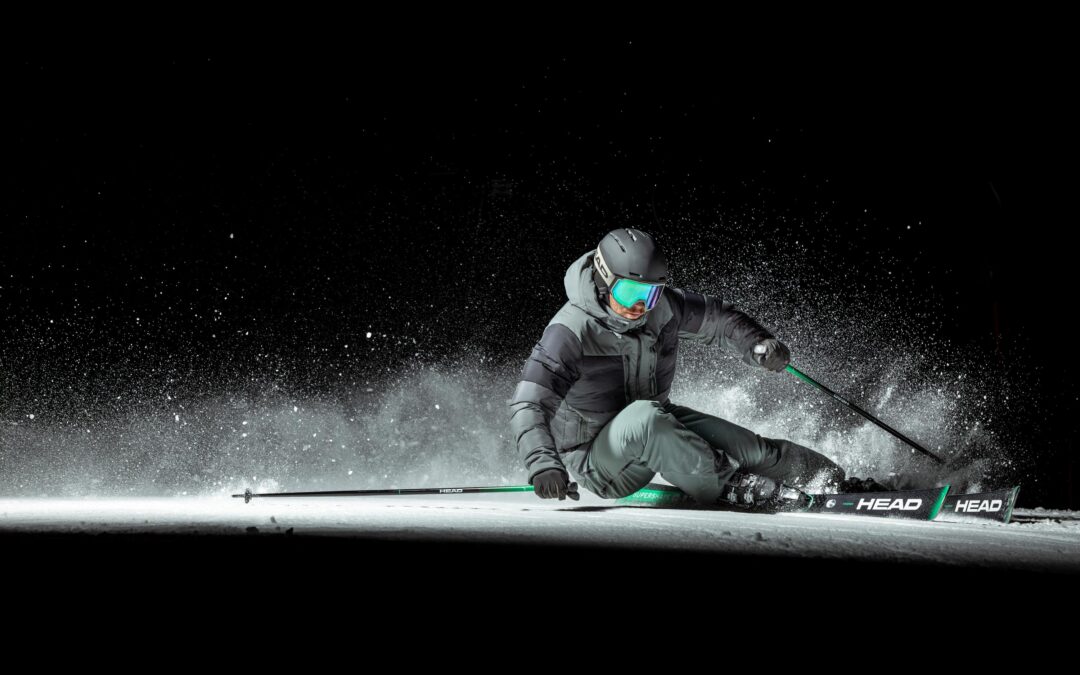
Head’s Kore series provides a perfect example of why a great off-trail ski and an ideal women’s ski share the same design criteria. In 21/22, the changes made to the unisex Kore collection were ipso facto applied to its women’s iterations. The same alterations that make the latest Kore 99 a better all-terrain ski also make the Kore 97 W a better women’s ski.
The most visible change was to the topsheet, which is now smoothly beveled so the ski slips sideways virtually without resistance, a big help when the snow is deep. A top coating of urethane was added in 2023, to help protect its fleece top. Inside, the Kore’s core was modified by eliminating Koroyd honeycomb and replacing it with more of its Karuba-poplar wood core. This delivers a subtle change in snow feel and feedback that makes the ride feel smoother and more predictable. The only thing the skier notices about the lightweight design is that it takes less effort to steer; there’s no sense of it being skittish or easily knocked off course just because it’s light.
As mentioned in the introduction to these reviews, we don’t usually recommend that a recreational woman use an All-Mountain West model as her everyday ride. But the Kore 97 W is so well balanced between its Power and Finesse properties and so confident in all conditions that it’s an exception to this rule.
The biggest problem with skis as wide as the Kore 111 is that their shortcomings start to show up as the powder “day” fizzles out around mid-morning. The Kore 111 could care less that the powder is kaput. Perhaps because Head replaced the Koroyd used in previous Kore cores with Karuba and poplar, the Kore 111 provides the feedback of a classic, wood and fiberglass chassis despite belonging in the same weight class as an anorexic Alpine Touring model.
I realize this sounds like a stupid thing to say, but the Kore 111 doesn’t ski wide, or at least not as wide as it measures, in part because it lacks Titanal laminates. Titanal accentuates torsional rigidity, which in turn augments the sensation of width because there’s no give along the longitudinal axis of the ski. Two sheets of Titanal is also a heavy load to haul around, particularly in powder, where they promote sinking over floating. The Kore 111 can afford to kick Titanal to the curb because it has Graphene in its guts, carbon in a matrix one atom thick that’s absurdly strong and damp.
The Kore construction didn’t need the 111 to validate its growing reputation as one of the great off-trail series of all time, yet it may be the archetypical Kore that epitomizes what this design does best. One of the defining characteristics of a great ski is its ability to perform tasks at an elite level that it was never designed to do. Starting from scratch, without design or cost limitations, I doubt anyone could make a ski better adapted to off-trail skiing than the Kore 111. Yet it transitions to hard snow so seamlessly you almost want to look down to be sure they haven’t shrunk to a Frontside waistline.
About the only caveat I can concoct is that the Kore 111 could use a little cushion to push against. By that I mean, if the top 1mm of the snow surface is unrelenting, of course it’s going to drift; but if there’s even an ounce of cream for the base to brace itself, the Kore 111 knows how to come around on a line. While we don’t recommend skis this wide for all-day, hard-snow skiing, the Kore 111 can handle it if you can.
The Head Kore 105 is the perfect ski for our times. No, it doesn’t promote universal love and understanding among all people, but it does what it can, considering that it’s a ski. It’s not just that it’s the lightest ski in the genre, it’s how that light weight contributes to a quickness off the edge that makes the Kore 105 feel narrower than its actual dimensions.
Another reason that the Kore 105 behaves like a skinnier ski is it adheres to a metal-free diet; the absence of Ti laminates softens its torsional rigidity, enabling it to conform to terrain rather than attempting to subdue it. This business about feeling narrower matters because it makes it reasonable to consider the Kore 105 as an everyday ski for western resort skiing.
Its ultra-light weight also makes the Kore 105 an ideal in-resort/backcountry hybrid. The biggest concern any backcountry skier has about a super-light ski is that it will be great going uphill and suck on the way down, which sort of defeats the whole purpose. There’s zero chance the Kore 105 will flame out on the descent, as it’s far more substantial than any AT model of which I am aware.
Another factor that makes the entire Kore series easier to steer off-trail is a beveled top edge that allows the ski to slice sideways almost without resistance. As foot steering is more necessity than indulgence when the snow is up to your knees, the smooth move the 105 makes laterally drastically reduces the amount of effort it takes to steer.
The final piece of the Kore 105 picture is a size run from 163cm to 191cm at 7cm splits. When selecting your ideal size, think about weight distribution – the more you weigh, the more ski you need – and flex. If you go too long, you might not be able to bend the ski, a necessity both for steering in general and for inducing the rebound energy that makes it effortless through the turn transition.
The current Kore 105 isn’t finicky about anything. There’s no need to adapt to it or ski it in any special way just because it’s light. Just hop on and ski as you naturally would. Only with less effort, a formula that works for anyone.
The Kore 103 W is the unisex Kore 105 with a slightly forward mounting point, in a limited size run of only 3 lengths. A strong, athletic woman might think of looking past the women’s size selection at a 184cm, in order to maximize flotation and stability at speed, but if you pay heed to the testimony of the plus-sized Jim Schaffner, that’s probably a bad idea.
“In the shorter size, I felt the 105 to have even greater range and playfulness than the 184cm,” asserted the founder of Start Haus and an active race coach. “I must credit Head for delivering a ton of performance in the Kore line. With the exception of the 105, I skied all of the Kore models in the 177, and they all had amazing horsepower for a svelte 230-pounder like me.”
Schaffner’s experience underscores the importance of length selection. I, too, skied the 2023 Kore 105 in both a 184cm and 177cm, and found the shorter length to be substantially more maneuverable, playful and fun. With Graphene in its design arsenal, Head can make a make a ski that’s as stiff as a brick or flexible as a reed, and can just as easily fiddle with the ski’s rigidity anywhere along its flex pattern. This is what allows the Kore 103 W to be supple enough underfoot for a lighter weight skier to bend it, but firmer flexing at the extremities, so it can provide enough support from tip to tail to keep a tank like Schaffner afloat… and grinning ear to ear.