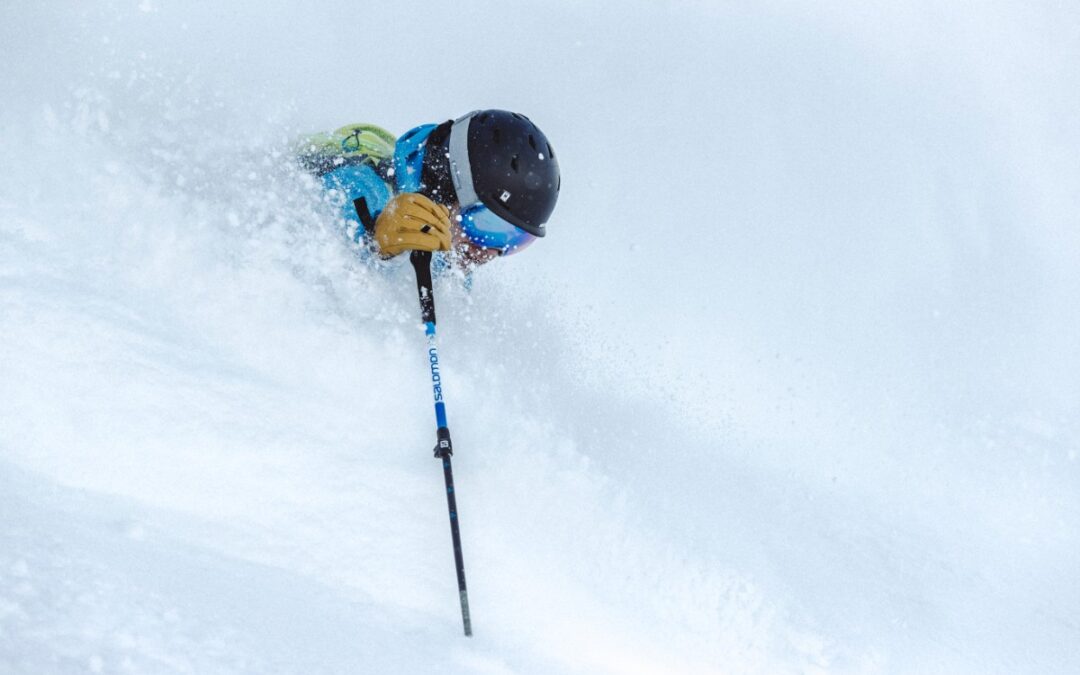
When Salomon launched the first edition of the Stance series in the 20/21 season, they were well aware that they were entering all-mountain categories already brimming with options. Most of the established image leaders in the pivotal All-Mountain West genre were Power models loaded stem to stern with dual Titanal laminates. To create some space for Stance in this crowd, Salomon had to both match what the category leaders were doing yet somehow be different from them. The solution was to replace swatches of Ti in the top sheet with its proprietary C/FX fibers, so the Stances would feel a bit less ponderous than the competition.
The changes instituted in the new Stance series took this effort at differentiation a step further, slightly disengaging the Ti top layer from the core, creating the sensation of a softer-flexing ski that’s still torsionally rigid enough to bite into boilerplate. Sally also lightened up the core by adding Karuba to what had been an all-poplar affair. The net effect is a high octane ski that is simplicity itself to steer. As incarnated in the Stance 102, the new changes transformed what had been a back-of-the-pack wannabe into one of the very best Finesse skis in the over-served Big Mountain market. Its nickname should be Crud Lite, for it excels in soft snow, where it maintains a mellow, fall-line orientation through thick and thin.
Among the traits that substantially boosted the Stance 102 in the Finesse rankings is its unusual ability to feel narrower than it measures at the waist. At least part of this sensation is due to a tail that is, in fact, narrower than the norm in the Big Mountain genre, so the ski has a tendency to gently release the turn after it crosses the fall line. The perception of being on a more tapered platform is accentuated by smooth, even flex that bows under modest pressure.
Jim Schaffner is an innately powerful technical skier with a penchant for speed. He found the Stance 102 to be “balanced and dreamy for my style and today’s packed powder conditions. Versatile and playful fun. Loved drifting into the soft stuff on the sides of the trail.” While it isn’t perturbed by hardpack, there’s no question that it’s in its bliss in soft snow. While some Big Mountain skis feel like battering rams that bludgeon crud into submission, the Stance 102’s svelte shape slices through tracked-up snow like a stiletto.
The Salomon QST 92 has risen from humble origins to its new position among the elite of the genre. Originally conceived to meet a lower price point ($500) and therefore underserved in the technology department, Salomon has been steadily enhancing its construction to match the latest innovations already added to pricier models, like the flagship QST 106. This year, the QST 92 adopted two features introduced last season in the QST 98, Double Sidewalls and full-length C/FX, Salomon’s signature carbon/flax combo.
While the latest improvements no doubt contributed to the QST 92’s stellar performance, the bones they’re built on were pretty stout to begin with: an all-wood (poplar) core, full sidewalls (i.e., no cap), cork inserts to muffle shocks and a central Titanal plate that makes the entire ski feel more substantial. The 2023 QST 92 also mimics the slightly lower rocker profile launched last year in the QST Blank and 98, so it feels more connected on all snow surfaces.
Once you put it all in motion, you wouldn’t guess you’re piloting a price-point ski intended to retail at $675. The security on edge is fantastic on anything softer than boilerplate, it feels energetic crossing the fall line and it can switch between a carve and a drift on command. A lower-skill skier can’t find a more tolerant ski with such a high-performance ceiling. For a ski whose DNA is all about off-trail conditions, the QST 92 feels right at home on groomers. It feels light and quick off the edge in bumps and placid as a glacier in long, spooling GS turns.
Jim Schaffner is a strong skier whose race background is evident in his every arc. The QST 92 he essayed was a 176cm, which I feared might fold up like a soft taco, but Schaffner stepped off the QST 92 with the bemused smile of the positively impressed. “The QST92 was very nicely balanced. I was feeling comfortable at all speeds, all turn shapes, on all snow conditions. I found that I could apply pressure to anywhere along the edge and get the ski to turn well.”
If you digest all the brochure copy expended on All-Mountain East models, you’ll find somewhere in every model description that it’s a “50/50” model, meaning it’s equally suited to skiing on-trail or off. What this seemingly innocuous shorthand term for a versatile ski masks is that no ski can ever truly be half-and-half, for every model is part of a design family that’s inherently biased to one side of the mountain or the other.
This prelude explains why Salomon felt compelled to create a second off-trail line, named Stance, when they already had a successful freeride series in the QST’s. The latter are unmistakably meant for the off-piste, so the QST 92 has the shape and construction of the series’ flagship, the QST 106. This means, among other things, that the AME QST 92 strives to be wide beam-to-beam along its entire length and aside from a mounting plate it has no metal in it.
The Stance 90 tilts the 50/50 equation in favor of Frontside features, beginning with two sheets of Titanal and a shallower sidecut with a more slender silhouette (126/90/108) that’s quicker edge to edge. Its square tail in particular is appreciably narrower than the norm in the AME genre, which keeps its orientation down the fall line.
Because of its build, the Stance 90 is a better short-turn ski and more confidence-building hard snow ski than the QST 92 it shares the AME space with. It probably has a little higher speed limit, too, but it’s not quite the rock star on fast, icy conditions that our top Recommended models are. But the skier looking for that relatively rare All-Mountain East ski that’s based on an on-trail template, the Stance 90 is a solid contender for your affections.
The Stance 84’s most stunning achievement isn’t its top-of-the-podium finish among our Finesse Favorites, or even its elite, on-trail performance; the headline story about Salomon’s Stance 84 is its off-the-charts value. The Stance 84 is slotted to sell at $499; there’s a slew of models slated to retail at $699 or more that can’t hold a candle to it.
There’s always a reason why a modestly priced model punches above its weight. In the case of the Stance 84, it’s because Salomon trimmed its most expensive elements without eliminating them altogether. The Stance 84 retains a single topsheet of Titanal, with the distinctive Stance cut-out in its forebody filled with carbon instead of Salomon’s signature super-fiber, C/FX. It turns out to be more than enough to keep the Stance 84 calm on edge when it’s rocking the groomed terrain it prefers.
We weren’t able to test the Stance 84 in off-trail conditions, but there’s no reason to think it wouldn’t do well. As a practical matter, the typical Stance 84 customer doesn’t ski off trail unless he gets lost. He’s more likely to need help mastering the basics on-trail, where the Stance 84 proves to be that rarest of gems, a true bargain. Every brand will tell you that its $499 model skis amazingly well – for its price. The Stance 84 skis amazingly well, period.