

Maybe it’s because I’ve spent what feels like several days in the clutches of AT&T customer service, a stretch of unrelieved aggravation that would roil the implacable calm of the Buddha, but the latest new product announcement to arrive in my mailbox ruffled my feathers. I realize my remarks are likely to be dismissed as the ravings of a 19th-century Luddite, which is almost accurate. Actually, my mindset more closely resembles that of an ancient Druid.
Those of my Dear Readers and Listeners who have read the odd chapter of Snowbird Secrets know that I believe skiing can open pathways of learning that are normally inaccessible. To achieve this level of cosmic connection with the mountain, the skier must be totally immersed in the experience. He or she must be present, so focused on the here and now that the separation between one’s movements and one’s essence disappears. Hold that thought while I return to the content of the press release that recently found its way to my desk.
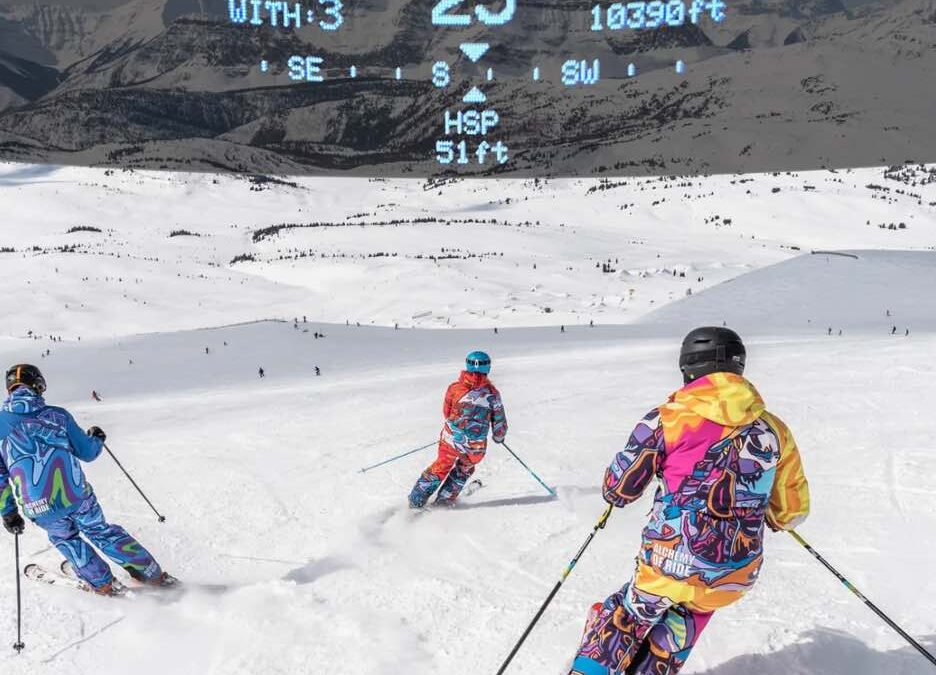
The latest appurtenance that all skiers will soon find indispensable is a new goggle named Rekkie that incorporates a display that will read your texts, answer your phone, keep tabs on all your friends, play your music and track your speed and vertical. All of this is right in front of your eyes, assaulting you with information and enticing you with distractions while you are supposedly engaged in the act of skiing.
I think my regular Dear Readers will recognize where I’m going with this tirade, but I’m not so sure those who sport these new goggles will be able to see where they’re going through the curtain of data dancing before them. It’s not just that this is all information you do not need to ski, nor even that some of it is likely to be wrong, but that it demands your attention be somewhere it shouldn’t be while you’re hurtling downhill on well-populated slopes.
Among the most celebrated of modern-day conceits is that people are capable of multi-tasking, despite the mountains of evidence that most people can’t handle tasks when taken one at a time, much less all at once. On the contrary, I find that many people are distracted all the time, usually by the digital devices in their hands or ears. With Rekkie goggles (and attendant app, of course), the art of distraction has been taken up a notch. The idea that some of the skiers around me may be more intent on the data floating around inside their goggles than they are with what is unfolding in front of them does not inspire confidence in my fellow man.
In the promotional literature, the number that looms largest in the skier’s field of vision is his or her speed, a figure that is almost certainly wrong. (See my Revelation of October 2, 2017, Deceptively Fast.) At least when a skier’s (inflated) speed was displayed on his or her phone, it wasn’t being dangled right before their eyes, daring them to go faster. I wouldn’t be at all surprised if it turned out to be the new goggles’ favorite feature.
How faithfully the goggles’ programming captures emails and text messages I have no idea, but their ready immediacy while I’m skiing sounds to me like a good way to ruin a ski day. I’m likewise not a fan of playing music while skiing, although I often start a song in my head just before I push off. (I’m particularly fond of Mixed Emotions, by the Stones.) It’s not that I don’t like music – I’m not that much of a curmudgeon – but I want to be able to hear my skis and all the other ambient sounds around me. I want to be able to hear the mountain channel the wind, and the soft crunch of compressing powder. Imported tunes muffle and distort the mountain’s own inimitable music.
The inspiration for this new accessory came to one of its creators when he became separated from others in his group; trying to reconnect ate up precious slope time, a sentiment I can definitely relate to. An app that tells you where everyone is sounds helpful, whether you’re trying to set up a rendezvous or avoid one. Of course, everyone you want to track needs to be outfitted with the same goggles and software, so connectivity comes at a fairly steep cost.
On that subject, a pair of Rekkie Smart Snow Goggles will run you $349.00 with the software/app package, or a mere $99 without. I’m not a goggle expert, but the un-smart version is priced well below most premium brands, which suggests the goggle may not be as sophisticated as its software. As I have no experience with the product, I’m in no position to judge its foundational qualities, but I hope its inventors didn’t attach all this technology to a so-so goggle. After all, a skier who is trying to track how the stock market is faring when he should be trying to dodge a sequoia he can’t quite make out, is not long for this world.

Related Articles
Just How Strange Will the 21/22 Ski Market Be?
To (temporarily) kowtow to the cult of brevity, the short answer is, “not very.”
To elaborate, most major ski brands didn’t derail the introduction of new products that were in the works well before the pandemic dropped the hammer. There’s a rhythm to the product renewal cycle that shifts the spotlight every year to a different model family within any brand’s global collection; that rhythm was largely respected despite the unique obstacles imposed on the process this year. If most of the models appearing in 21/22 catalogs seem similar to what was offered this year, it’s because this is how the line renewal machinery ordinarily operates.
What’s difficult to judge from outside the R&D pipeline is what we’re not seeing. That is, were there more new models or upgrades to existing star products ready to launch that were put on hold to avoid overloading a potentially weakened distribution network? Possibly; what might have been a planned six-model launch may have been trimmed to three or four, for example.
Happily, there’s no real downside to this scenario for the prospective ski buyer. All essential model family refreshing and line extensions will unfold as forecast. If you haven’t bought a ski in three or four years – I believe the average span between new ski purchases is over seven – the entire universe of Alpine skis is new to you. You may spot some names you recognize, but the skis that bear the name will almost assuredly be different.
“How Is It in The Bumps?”
This question is one of the last objections a ski buyer tosses into the flow of the sale just as the salesperson has guided it to the brink of consummation. To keep the impending close on course, the suave salesperson will hedge the issue with some bland reassurance without raising the obvious retort, that no ski can overcome all the many and curious ills that plague the untalented mogul skier.
A great skier can manage bumps no matter what ski he or she is on. That doesn’t mean experts don’t have favorite skis for this spine-rattling condition, but they don’t need to change skis just because they encounter a bump field. They’ll manage, and chances are anyone watching them won’t be able to tell if the ski is helping, hurting or just along for the ride.
To get the subject out of the way, there are such things as mogul skis, but they’re made for competitors, not your everyday, all-terrain skier. Their tiny (61mm-66mm) waists and svelte sidecuts were common 25 years ago, but they’re as rare as bacon at a bar mitzvah today. Unless you’re planning to compete, there’s no reason for you to fish in this pond.
The Savvy Shopper: How to Buy Skis
Let’s begin with a recap of the fundamentals.
Realskiers’ model selection methodology starts by dividing the Alpine ski market into seven categories, using waist width as the organizing principle for three excellent reasons:
1. This dimension is the single best indicator of the ski’s capabilities.
2. Waist width is a hard number, not a fuzzy concept like skier type.
3. Suppliers product lines align with this method, creating models in every category according a coherent pricing logic.
