

So much snow has fallen this season at places like Snowbird and Mammoth, it’s quite possible these resorts (and others in the American West) could remain open until the calendar rolls right into the 23/24 season, without missing a day. While I doubt this will actually happen, the two ski seasons will be nearly indistinguishable when it comes to what Alpine ski models line the walls at American shops. Only a handful of new models will infiltrate the ranks of what’s available, and some of what’s new will be in genres that American skiers generally shun, intensifying the overall impression of déjà vu.
Anticipating this development (on the market front, not the weather front) at the start of the current ski season in my 2023 ski market preview, I wrote that we were in a golden age of incrementalism, in which relatively minor design alterations would be the norm. Seismic shifts like the Carving ski craze, the rise of fat skis, the ubiquitous, conjoined adoption of tapered tips and tip-and-tail rocker, even the gradual extinction of skis over 200cm, are all products of an earlier era. There may be some truly amazing ski design being prepped for a 2025 roll-out, but there’s nothing in the current ski market to suggest this is likely.
I don’t mean to be dismissive of the improvements made in the handful of model families that were redesigned for 23/24; construction upgrades are always beneficial, even if they are variations on established foundations. In the all-important All-Mountain categories, the re-vamped Blizzard Rustler, Salomon Stance and K2 Mindbender C collections are prime examples of model designs that have evolved while maintaining their essential identity and relative position within their respective lines.
Aside from the three model families cited above, there’s not much other activity due to debut next fall in the categories American skiers care about. At least part of the reason that the pace of Alpine ski product development has been slowing down is the boom in the backcountry, aka Alpine Touring, market. Even before the pandemic accelerated skiers’ desire to get away from the crowded resort scene, ski suppliers were diverting resources into gear made, to one degree or another, for climbing uphill. Nowadays, it’s not unusual for a ski maker to tout three separate lines of touring models, lest any sub-niche go unserved.
While I don’t pretend to be any kind of an expert on the subject of backcountry gear, I’ve always been of the opinion that the typical American resort skier isn’t cut out for the rigors – not to mention the expense – of Alpine Touring. I’m certain that the recent surge in sales of BC gear will grow the base of AT participants, but I’m equally certain that most American skiers who are likely to be captivated by the whole hike-to-ski experience have already acquired the necessary gear sometime in the last four seasons. Specialists in this domain will, I suspect, continue to thrive, but the big bulge in out-of-resort equipment activity seen over the last few seasons is probably not sustainable.
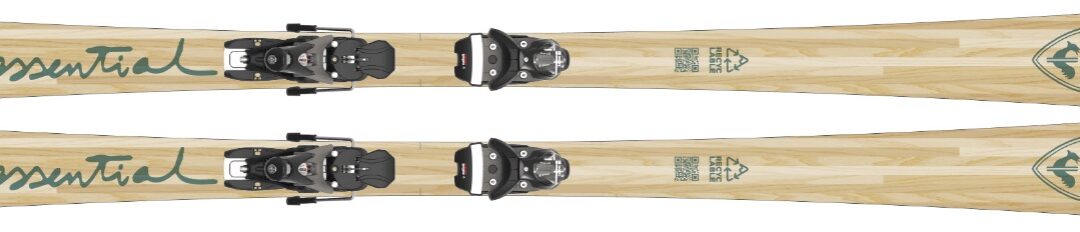
The most important ski to pop on the radar this year isn’t an upgrade to any previous model, nor is it an extension of an established model family. It’s a stand-alone statement about the direction ski construction could take if it adopted a more environmentally friendly design. Made by Rossignol, the Essential sounds like a PR stunt – 77% recyclable! – but skis like a purebred race slalom. The Essential is one of the rare skis that has a story behind it that’s more important than the model itself, despite the fact that, from a performance standpoint, the Essential outshines most of the existing market. The sorry truth is, if the Essential had to stand solely on its performance merits, it would have gone completely unnoticed in a nation that has tuned out narrow-waisted Technical skis like the Essential. By making the Essential the standard bearer for environmental activism, perhaps Rossi can entice a few Americans back on the sort of ski that used to dominate American ski sales.
The More Things Change…
One sign of the maturity of the Alpine ski market is that the market segmentation system (based on waist width measurements) that I first promulgated over a decade ago still holds true today. Likewise, the best advice on how to approach a ski buy hasn’t significantly evolved, as revealed in a Revelation titled How It Works, originally posted on May 7, 2013, and retrieved from the Realskiers Revelations Archives last week by yours truly. The observations and advice provided ten years ago could have been written yesterday. The big picture hasn’t changed one whit.
While the best approach to ski buying hasn’t deviated in over a decade, during that same span every brand has tweaked every model in its various collections at least once, and more commonly, two or three times. So, the case could be made for slowing the pace of model turnover, were it not for the fact that perceived innovation is a significant driver in new ski sales. For most major brands, product renewal rolls through its collection, family by family, on a schedule that in many instances wasn’t even delayed by the pandemic.
This well-established rhythm of product evolution means that the 2024/25 season could be a banner year when several iconic models shed old skins. But even when important models undergo a makeover, the brand behind them doesn’t want to tinker unduly with what has been a successful formula, nor do they want to incur the staggering expenses that introducing totally new technology can entail. The need to hew closely to the status quo (read, exploit already committed capital investment) will always be at odds with the urge to innovate in directions that have no precedent.
Boots Steal the Spotlight
If you think it’s hard to genuinely innovate in ski design, try creating a new Alpine boot. There are reasons why all 2-piece, four-buckle boots look alike. There’s only been two successful deviations from this archetype, the 3-piece, external tongue design and rear-entry, and the latter has fallen in such disrepute that it’s largely consigned to rental fleets. The plastic, overlap shell designs that evolved from leather boots have remained conceptually unaltered since the Lange and Nordica incarnations settled on two classic chassis over three decades ago.
The intractable status quo is about to change. Lange is introducing a new model, slotted to replace the RX series, called Shadow. The Shadow design departs from the norm in several important ways, creating a high flex-index boot that is nonetheless easier to drive into and, more importantly, possesses an extra measure of rebound energy, all without compromising lateral or rear support. The ingenious way the cuff and lower boot are connected enhances the reactivity of the whole, while the totally redesigned inner boot assures a level of comfort never before associated with a Lange boot. I’m not privy to anyone’s sales figures, but if my suspicions are correct, Shadows will be hard to keep in stock.
The other big news on the boot front is the application of BOA fit systems in place of forefoot buckles on boots from Salomon, Atomic, Fischer and K2. For skiers who are particularly sensitive to pressure over the instep, the lacing system on the BOA-equipped boots should hold the forefoot without dropping the roof on the mid-foot. But when it comes to model selection, how well a boot holds the rear-foot (heel and ankle) is far more important than whatever pressure may be felt in the forefoot, where bony prominences are relatively easy to work around. That said, skiers love convenience features, like the step-in bindings that made Salomon its first fortune, or rear-entry boots, that earned the then-French brand its second tsunami of profits, which in turn funded the acquisition of Taylor Made. Point being, just because convenience features may not contribute directly to improved performance, doesn’t mean that the vast majority of recreational skiers won’t embrace them.
For a better-informed opinion on the relative virtues of the Lange Shadow, BOA-enabled boots or any other important boot models coming to market in 2023/24, please consult America’s Best Bootfitters when it publishes the results of the 2023 Masterfit Boot Test, recently conducted on the slopes of Mt. Bachelor, OR. For the most complete coverage of all matters related to Alpine skis, Realskiers.com is the only online resource worthy of your consideration.

Related Articles

Road Tripping
Among the many dissatisfactions of this most unusual season is that travel beyond one’s local environs has been roundly discouraged. Don’t get me wrong: I’m grateful down to my socks that we’re allowed to ski locally, and my version of same is pretty sweet. Pardon the plug, but between Alpine Meadows, Squaw Valley and Mt. Rose I have a smorgasbord of savory choices.
But skiing close to home and skiing on the road are two different beasts. Nothing is the same, really, and therein lies a great deal of the road trip’s charms.
To shed light on my premise, allow me to pull back the veil on my favorite away game, an annual pilgrimage to Little Cottonwood Canyon. By the end of this brief travelogue you will probably hate me, so please fill your vessel of good will to the rim before proceeding.
It’s About Nothing
In the last week of January,2009 I was able to spend a few days skiing in Little Cottonwood Canyon, which is always cathartic for my ravaged soul. The conditions were all over the map, the mountains having experienced a long, hot spell followed by rain, grapple, wet snow and finally dry snow driven by winds that could flense an adult walrus in a few minutes. Couldn’t have been better.
I had been preparing for the trip for weeks, psychologically. Two back surgeries the previous winter had reduced my training regimen from semi-annual to non-existent. Scheduling conflicts such as work kept me from visiting the areas that abound at home near Lake Tahoe, so I had zero ski days on a body with more fat on it than a French duck. I had as much chance of surviving Snowbird and Alta as a rib roast in a piranha tank.
Fortunately, the Lord is merciful, anti-inflammatory drugs are powerful and there are techniques that allow one to block out pain. There are also many wonderful people in this world with which to ski, kind people who stand quietly by, pretending to be in awe of Nature, while my chest heaves so violently in its futile quest for oxygen that tiny lung particles break lose and make for the exits. One such person is Guru Dave Powers, a man whose passion for the sport hasn’t diminished after thousands of days of riding gravity down the infinitely variable slopes and crannies of Snowbird. The Goo knows this hill, and in knowing it well knows so much more.

The Making of a Skier, Chapter XII: Putting Words into the Mouth of God & Other Mid-Life Adventures
When I was cut adrift by Head on June 13, 2001, my once glowing prospects dimmed considerably. The date is etched in memory because I hosted a small soirée that evening in honor of my darling wife’s 50th birthday. One of the attendees was Paul Hochman, who would play several roles in my life as I wandered in the wilderness of unemployment during what were supposed to be my peak earning years.
During the gaping hole in my career that spanned 2001-2011, I would eventually spend every cent of my inheritance, plus most of what I’d saved from earlier bouts with gainful employment, just keeping the household afloat. Despite a river of red ink, my resume would suggest that I was not only commercially active during this epoch, but had my hand in all sorts of ventures.
