
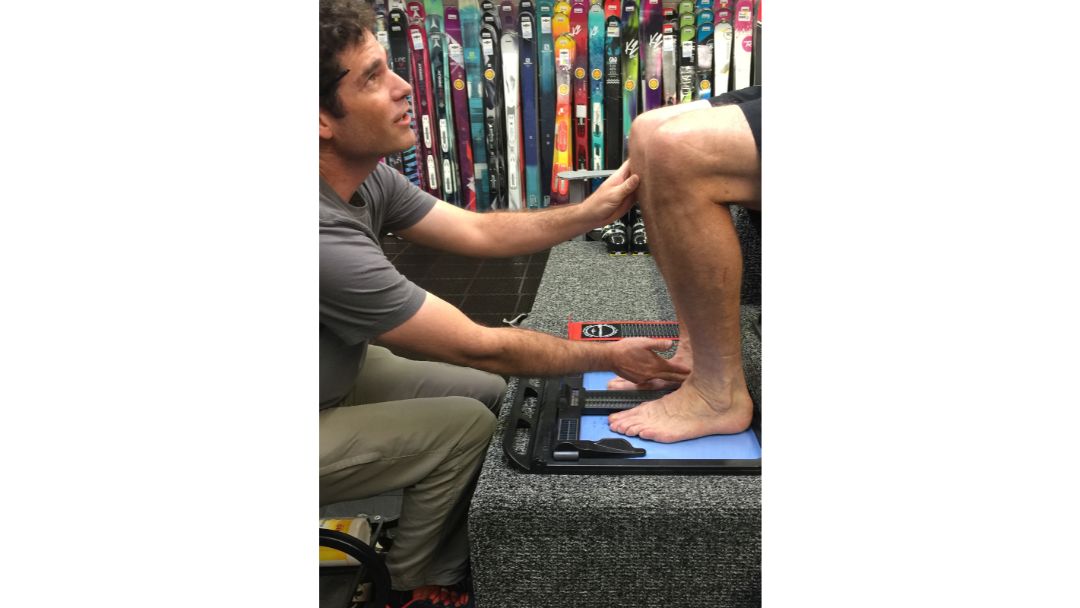

I’ve recently returned to the front lines – known colloquially as the bootfit bench – as there’s snow on the ground here in Reno and the frenzy has started. As usual, every encounter with live subjects reveals a trove of knowledge, or perhaps I should call it, “anti-knowledge,” the morass of misconceptions that all too many skiers mistake for the truth.
Last week, I introduced you to Mike, the Internet shopper who came in with a hodgepodge of gear that would have hobbled his ski development until he got rid of it. Fortunately for all concerned, Mike recognized good advice when it was sitting in front of him, and made an appointment to see me later. That session has since transpired, putting Mike in a boot of the right size and flex along with a little re-molding around a couple of pressure points. He also has a ski that will serve him well both now and in the foreseeable future.
Mike’s tale is one that will be re-told hundreds, if not thousands, of times this season. I’m revisiting his story here because I want to underscore the point that this is the best possible outcome for the Internet shopper, particularly someone who isn’t exceptionally knowledgeable. By all means, use the Internet for research, but do not hit the BUY NOW button. You’ll never be able to optimize your equipment by long distance. It’s the definition of a fool’s errand.
Another classic case study I encountered this past weekend concerned a young lad we’ll call Caleb. He told me he’d been skiing since he was four, but now that his feet had stopped growing, it was time to make the transition from renting boots to owning them. I subjected Caleb to my usual diagnostic routine and soon had him in a properly sized shell, albeit one with too stiff a flex. Once I put him in a slightly softer-flexing version of the same boot, it was clear sailing to a happy conclusion.
All that was left to do was make what I presumed would be a minor adjustment to the bindings on Caleb’s skis. That’s when I discovered that the rental boot to which Caleb’s skis had been mounted had been roughly two shell sizes larger than the one I had just custom-fit to him. This oceanic size difference illustrates the chasm that separates how rental boots are fit compared to retail boots. It’s easy to deconstruct how this came to be: in the rental fitting process, if the customer squawks, the solution isn’t to stop the process to customize the boot, but to simply get a bigger boot until the squawking is reduced to a whimper. Problem solved!
Why recite the Book of Caleb? Because I want my Dear Readers to realize that if they’re at all serious about becoming decent skiers, they must make the leap from rental to retail. It is the single most transformative thing you can do for your development as a skier. As a bonus, a proper bootfit will directly contribute to safer, more balanced skiing.
A Profile in Courage
My most rewarding bootfit session of the new season also happened to fit the profile of the ideal bootfit scenario. It began, as the optimal bootfit session should, with an appointment. My client – let’s call her Mary – sought me out at the suggestion of her surgeon and made a date to see me via email. Mary turned out to be a lifelong skier despite suffering a gruesome injury at the tender age of 18, a compound, double fracture of the lower leg that never properly healed. Mary was coming off a subtalar joint fusion, which involves driving a screw up from the base of the heel, through the calcaneus and into the talus, the keystone bone in the center of the ankle. Her physical therapist determined that the post-surgical swelling was reduced sufficiently to try to put her in a new ski boot, which was the state of affairs when she sat before me last Thursday.
A detailed interview and inspection of Mary’s all-but-destroyed lower leg made plain her plight: that foot was flat as a board with zero range of motion. She was seeing me because she could no longer manage to insinuate her inflexible foot into a four-buckle boot like the one she currently owned. Mary made an ideal bootfit subject in part because she had a thorough understanding of her condition and what had been done to date to alleviate it. I didn’t tamper with the ¾-length orthotic device installed in her old boots, but the boots themselves had to be retired.
I ended up selecting an over-sized, rear-entry design that had a large enough aperture to squeeze her traumatized foot into the shell, where it was held securely in the rear by the well-matched shape of her arch support and the foot’s limited ability to move fore and aft. Mary could now resume her life as an active skier.
Mary, by the way, is 69. She’s been skiing a half a century more or less on one leg. She never once complained to me about her circumstances, maintaining a sunny disposition when she had every reason to be sullen. Skiers like Mary are the reason I fit boots. Their bottomless courage, their unyielding resolve, their willingness to disregard the limitations life has thrown in their way, inspire me to be my better self.
Before I dismount my soapbox, I want to remind those of my Dear Readers who also toil in ski shops across the land, to take full advantage of The Returning Skier’s Handbook, which you’ll find under the Gear Guide menu on Realskiers.com. As the title suggests, I created this digital handbook to inform skiers who have been away from the sport for a while about how things have changed. But it also works as a refresher course for anyone who isn’t embedded in the sport. The Returning Skier’s Handbook is non-denominational, does not hype any brands in particular and is utterly devoid of advertising.
I mention it here because the 22/23 ski season is off and running, and I doubt there’s a single shop in America that would self-describe as over-staffed. (That’s another reason why bootfitting appointments are always a good idea.) The Returning Skier’s Handbook can keep a customer occupied while he or she is waiting for a bootfitter to return from the stock room or while boot mods are being done. I turned a young couple onto the Handbook last weekend and they ending up with everything, from custom insoles to clothing, skis, boots, bindings, poles, socks, you name it, they got it. Point being, the RSH will help you make sales that will also improve the ski experience for your precious customers, and in the end, that’s what it’s all about, and that’s how it’s supposed to work.

Related Articles
How It Works.
Why You Should Buy From People Who Know What They’re Doing And Have Your Best Interests at Heart Everyone wants a deal. So here’s the deal: every authorized dealer in the US signs a Dealer...
In Praise of the Wandering Mind
This subject has been percolating in the subterranean strata of my noggin for several months, searching for the connections that will lend it substance. The search for this topic’s handles has a wedding-cake’s worth layers: to depict the wandering mind requires its engagement, a self-cancelling concept that would oblige me to catch and release the idea in a Sisyphean quest to define its merits.
The notion of expounding on this Möbius strip of an idea was, naturally, an example of the wandering mind in action. I might have been noodling on a question several of my Dear Readers have posed, which can be distilled to, how did I ever learn to write in the manner that I do?
To find my answer, I had to relax my grip on the subject. My reasoning self was ready with mechanical answers, such as the discipline of writing every day. Duly noted, but insufficient. Let’s wander a little further.
Yard Sale! When Going Big Goes Wrong
If you’ve been a lifelong skier, you’ve not only experienced failure; most likely you’ve survived at least one miscalculation so soul-scarring, its time capsule is enshrined in the halls of memory alongside weddings and funerals.
As inspiration and prod to memory, allow me to recount a vignette from my days as a freestyle competitor. The location is Keystone, Colorado, the event, The Chicken of the Sea Freestyle Classic, a sponsorship coup that couldn’t have been too tough to land as Ralston Purina owned both the resort and the tuna.
I qualified via a preliminary aerial competition, taking a conservative tack by throwing a mule kick, hardly daring when going upside down was common. But my modest move was clean and hung out to dry, with a barely discernible, weightless pause at its apex.
