
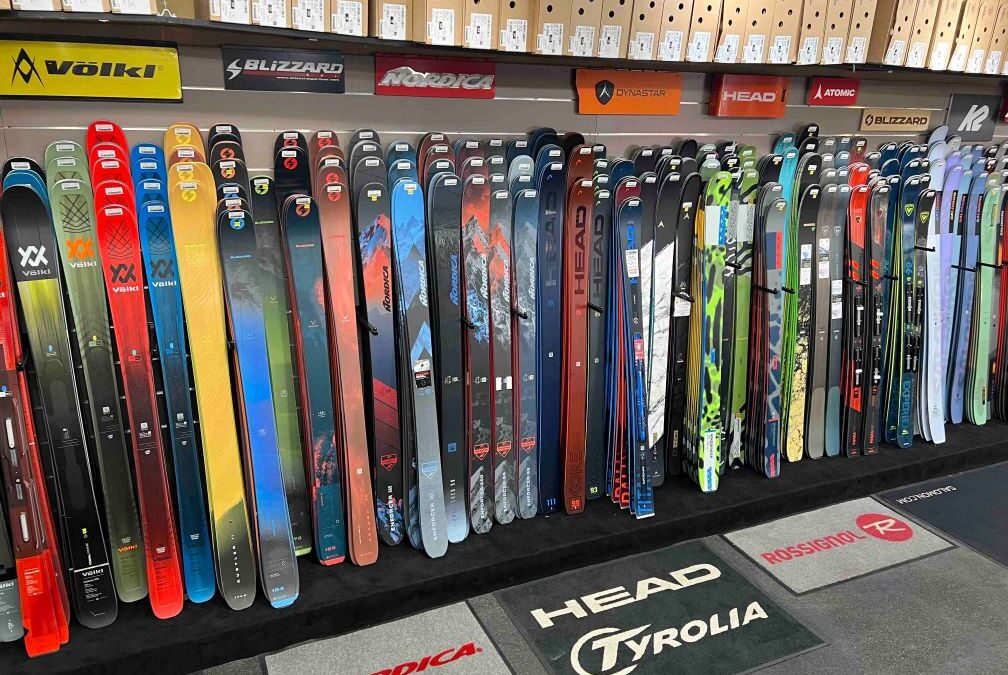

This Revelation should have been titled, “Price Isn’t the Primary Criterion Anymore,” but that’s not as catchy as “Price Is No Object.” Apologies for any attendant confusion.
As consumers, we are trained to shop for the lowest price. The unfettered free-for-all that is e-commerce drives this point home with every search, by helpfully displaying the low-ball leaders prominently on the front page. I realize that despite what I am about to say, skiers will continue to root around the Internet for the lowest price as that’s what the online bazaar does best.
The point of today’s focused pensée is that the top tier of 2024 ski models in any given category will all sell at the same price, give or take $50. I mention the $50 fudge factor, not to identify where you can save fifty bucks, but to underline the insignificance of this amount over the likely ten-year tenure of a new pair of skis.
To put it in slightly different terms: do not let a $50 price difference govern your decision.
Muddying the waters of price comparison shopping is the gradually receding practice of having two published retail prices, one the traditional Manufacturer’s Suggested Retail Price (MSRP), and the other a Minimum Advertised Price (MAP), originally intended to demark a low-water-mark retail for new models but which quickly became the de facto retail price for virtually all major ski brands.
Then along came the pandemic, and with it the need to raise prices to help cover skyrocketing distribution costs. Rather than jack up the fictive MSRP, most suppliers chose to simply euthanize the MAP and anoint the MSRP as the one-and-only public price, thereby raising the price without appearing to raise the price. The few major brands that have continued to suggest an MSRP that is above the market norm all have a MAP that brings the actual cost to the consumer back to parity with the pack.
To illustrate my proposition (that skis generally arrive at the same retail price for a given genre), I compiled the public pricing for 15 models in the hotly competitive, image-setting Men’s All-Mountain West category. Eight set the norm at $799, four were slotted at $749, one was $50 on the high side of the mean, and two belonged to outliers Kästle ($1,199) and Stöckli ($1,249), whose luxury price tags presumably add to their cachet. Given that all but two perennial contrarians are within $50 of the de facto norm, price ought not be a significant factor in model selection, with the exception of atypical brands who clearly aren’t attempting to compete for your affections based on price.
To all the commissioners of the FTC who read my weekly Revelations, please don’t get your knickers in a knot over what appears to be industry-wide price collusion. The overall number of major brands that sell through the brick-and-mortar retail channel is small, some 12 to 16 in number, depending on who’s doing the counting, and the number of brand ownership groups is even smaller. Everyone knows how everyone else’s stuff is made, and they all shop for materials in the same marketplace. Given that all suppliers are dealing with what are intrinsically artisanal production methods and a seasonal sales cycle that’s weather-dependent, it shouldn’t be surprising their pricing coalesces around the same levels. (All things considered, it would be far weirder if there were a wide price dispersion for a given end user.)
Whither the deals of yesteryear?
Pricing for new, 2024 models may be at virtual parity, but there’s a parallel world of 2023 models still circulating through the marketplace, and every last one of them is on sale. Once a ski has passed its first birthday, its market value takes an immediate haircut, if not a scalping. Online megastores that fail to move their inventory in-season dump it at fire-sale prices via the ubiquitous top banner of Internet search results, and even some suppliers now sell their forecasting mistakes directly to the public at substantial discounts. The devaluation of the prior year’s products is a particular boon to the budget-conscious skier when there’s minimal model turnover, as was the case this year.
As has been the case since, well, forever, the best place to shop for bargains is the secondary market, particularly at fall ski swaps, ski-team fund raisers and pre-season sales, where the selection of used gear is likely to be the deepest you’ll see all season. I’ll reiterate my evergreen precaution to anyone dragging the bottom of the ski market for bargains: your best protection against committing a buying bummer is to know exactly what you’re looking for.
Benediction
If you do end up acquiring a fresh set-up this season, permit me to be the first to say, “thank you for choosing ownership over rental.” Someone has to keep motivating manufacturers to make better equipment for the rank-and-file skier, or the market will drift to opposite poles: competition skis to promote the brand internationally, and rental skis of one ilk or the other for everyone else. Every ski bought at a specialty ski shop (or its website) this season will help keep skiing alive one more year for real skiers.

Related Articles
Just How Strange Will the 21/22 Ski Market Be?
To (temporarily) kowtow to the cult of brevity, the short answer is, “not very.”
To elaborate, most major ski brands didn’t derail the introduction of new products that were in the works well before the pandemic dropped the hammer. There’s a rhythm to the product renewal cycle that shifts the spotlight every year to a different model family within any brand’s global collection; that rhythm was largely respected despite the unique obstacles imposed on the process this year. If most of the models appearing in 21/22 catalogs seem similar to what was offered this year, it’s because this is how the line renewal machinery ordinarily operates.
What’s difficult to judge from outside the R&D pipeline is what we’re not seeing. That is, were there more new models or upgrades to existing star products ready to launch that were put on hold to avoid overloading a potentially weakened distribution network? Possibly; what might have been a planned six-model launch may have been trimmed to three or four, for example.
Happily, there’s no real downside to this scenario for the prospective ski buyer. All essential model family refreshing and line extensions will unfold as forecast. If you haven’t bought a ski in three or four years – I believe the average span between new ski purchases is over seven – the entire universe of Alpine skis is new to you. You may spot some names you recognize, but the skis that bear the name will almost assuredly be different.
“How Is It in The Bumps?”
This question is one of the last objections a ski buyer tosses into the flow of the sale just as the salesperson has guided it to the brink of consummation. To keep the impending close on course, the suave salesperson will hedge the issue with some bland reassurance without raising the obvious retort, that no ski can overcome all the many and curious ills that plague the untalented mogul skier.
A great skier can manage bumps no matter what ski he or she is on. That doesn’t mean experts don’t have favorite skis for this spine-rattling condition, but they don’t need to change skis just because they encounter a bump field. They’ll manage, and chances are anyone watching them won’t be able to tell if the ski is helping, hurting or just along for the ride.
To get the subject out of the way, there are such things as mogul skis, but they’re made for competitors, not your everyday, all-terrain skier. Their tiny (61mm-66mm) waists and svelte sidecuts were common 25 years ago, but they’re as rare as bacon at a bar mitzvah today. Unless you’re planning to compete, there’s no reason for you to fish in this pond.
The Savvy Shopper: How to Buy Skis
Let’s begin with a recap of the fundamentals.
Realskiers’ model selection methodology starts by dividing the Alpine ski market into seven categories, using waist width as the organizing principle for three excellent reasons:
1. This dimension is the single best indicator of the ski’s capabilities.
2. Waist width is a hard number, not a fuzzy concept like skier type.
3. Suppliers product lines align with this method, creating models in every category according a coherent pricing logic.
