
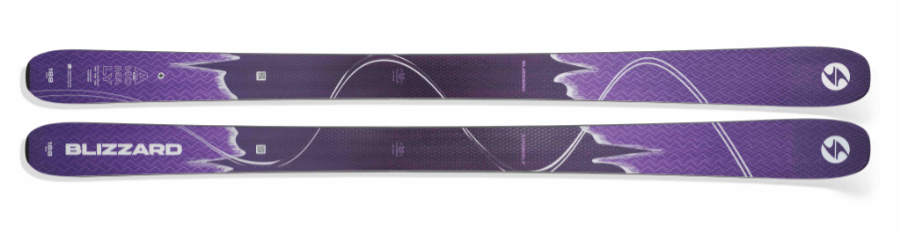

Rest assured, Dear Readers, that this Revelation is not a discourse on Nietzsche’s sermon about the end of religion; the idols to which I refer aren’t gods, but a coterie of iconic ski models that have consistently exhibited “best in class” qualities over the course of the last decade and are finally approaching their sell-by date.
I’m not privy to any hard facts about which of the retiring models actually sold the most, so I can’t say with any degree of certainty which of the flagships now sailing into their final sunset can boast about having been the most popular. And it should be noted that I’m not referencing world-side sales, but only those logged In the U.S., where the most popular models are generally broader in the beam than their European counterparts.
The retirement of this all-star cast is occurring against a backdrop of a geyser of new models bearing familiar names, with three or four times the number of “new and improved” models as there were this season, spread across the four core categories: Frontside (75-84mm), All-Mountain East (85-94mm), All-Mountain West (95mm-100mm) and Big Mountain (101mm-113mm). It’s been years since we’ve seen this degree of impending model turnover.
Bear in mind, all it takes to qualify as “new” is some change in shape and/or substitution of materials that differs from the previous incarnation. As I’ve noted many times in these pages, we’re living in an age of incremental innovations. No brand is interested in re-tooling an entire factory. Brands tend to stick to their wheelhouse capabilities, no matter how they configure a ski’s shape, baseline or flex behavior.
The Big Three Take a Bow
One of the pillars on which a brand’s reputation rests is its popularity with the best skiers on the mountain, which makes the All-Mountain West genre the linchpin category for any brand striving for top-of-mind presence among influential experts. For most, if not all, of the last decade, the kings of the AMW mountain were the Blizzard Bonafide, the Nordica Enforcer 100 and the Völkl Mantra. There were many pretenders to this 3-seater throne with elite resumes – after all, these are all expensive skis that showcase a brand’s best all-terrain technology – so everyone puts their best foot forward. Just about every model in the genre can make a case for why it should share the crown, a task AI could perform in less time than it takes to finish this sentence.
In case of any of my Dear Readers would like to experience the amoral elasticity of AI, pick any 3 skis you fancy and ask your preferred chatbot to make the case that they are the best all-mountain skis available. Prepare to be both amazed and appalled by its speed and the confidence and conviction displayed in its judgments. But I digress…
By next season, all three of the aforementioned legendary models will be retired. The Blizzard Anomaly series won’t even have an All-Mountain West entry, as the new series brackets the AMW genre with 94mm and 102mm models. Which way the market wind will blow is impossible to say as I write this, but I wouldn’t be surprised if both these Anomalys proved equally popular. All four of the new Anomaly series use a variant of the Fluxform construction introduced this season in the Rustler and Sheeva collections.
Nordica is keeping the Enforcer name, but very little about the new Enforcer 99 is the same as the pater familias of the Enforcer clan it replaces. Its rockered tail is higher and longer, so it allows the edge to release and smear. What’s inside has also been re-modeled, sandwiching wood and two sheets of Titanal around a flexy elastomer center, for a ride that is at once powerful and satin-smooth. All of the new, four-model Enforcer field share the same design alterations. (The four-model Santa Ana series has also been revamped.)
At Völkl, the M7 continues a transformation that began with the M5 several years ago, tweaking the sidecut of this venerable model to further facilitate switching between long-radius turns and short. (The women’s Secret 96 has undergone the same enhancements.) If the improvements to the M7 aren’t as extensive as what is transpiring this year with the Enforcers and Analogs, it’s perhaps because Völkl has staggered the timeline for its various enhancements to the basic Mantra design over the past several seasons. And the M7/Secret 96 aren’t the only newbies in the 2025 Völkl collection; the Deacon line-up is getting a complete shake-up and the Blaze 104 and 94 are getting wall-to-wall Titanal underfoot, a real game-changer.
While we’re on the subject of transforming iconic models, we must mention that Blizzard has adapted the Fluxform design it introduced this year to its sales-record-setting Black Pearl 88 (and two siblings, the Black Pearl 84 and 94). No other ski, men’s or women’s, has had such a streak of dominance in this millennium. Now the most popular ski of its era is about to get better.
While there’s no other trio of AMW models that have enjoyed the same level of sustained success as the Bonafide, Enforcer and Mantra, they’re but three examples of a nearly industry-wide wave of product renewal transforming the market landscape.
- Kästle has re-designed its fabulous MX series and euthanized its FX family in favor of the 3-model Paragon posse, all possessing a similar construction to the departed FX’s, but with more taper at the tip and tail.
- Head has rejuvenated its carving-category-crushing Supershape series, featuring a new plate that neutralizes the ramp angle bias built into system skis. They remain the carving collection against which all others are measured.
- Rossi upped the performance ante at the top of its EXP series, adding Line Control Technology to two new models that have carved out a new niche called Arcade.
- Dynastar has switched the core of the new M-Pro 100ti and 94ti to the Hybrid Core 2.0 intro’d in the M-Cross this season. The new M-Pros are also a bit more shapely, with a longer front rocker and more kick to the tail rocker profile, with an eye to making the new models more playful.
- Atomic didn’t just improve the performance of its two new Maverick models, the Maverick 115 CTi and 105 CTi, it also ditched enough glass and resin from the old design to significantly reduce the environmental impact of their production.
Sustainability is also the driving force behind a new Curv model at Fischer, the Curv GT 85 Redefine. While it’s only one model in a 6-model series, it serves as a demonstration of what can be done with more sustainable sourcing and processes. For the moment, skis like Rossi’s The Essential (introduced last year), Atomic’s new Mavericks and the Fischer Curv Redefine are important first steps towards environmentally friendly constructions that take into account the entire lifecycle of the ski. It is a journey that will most likely require collaboration among brands, and will surely be attracting more investment in the near future.
If I’ve incited an itch to obtain a 2025 model ASAP, keep your long undies on. While a handful of launch models inevitably seep into the marketplace, most brands realize their dealer network is already sufficiently supplied to carry them through this season. Now is an ideal time in the season to demo a handful of 2024 models while the supply line is relatively well stocked with options.

Related Articles
Just How Strange Will the 21/22 Ski Market Be?
To (temporarily) kowtow to the cult of brevity, the short answer is, “not very.”
To elaborate, most major ski brands didn’t derail the introduction of new products that were in the works well before the pandemic dropped the hammer. There’s a rhythm to the product renewal cycle that shifts the spotlight every year to a different model family within any brand’s global collection; that rhythm was largely respected despite the unique obstacles imposed on the process this year. If most of the models appearing in 21/22 catalogs seem similar to what was offered this year, it’s because this is how the line renewal machinery ordinarily operates.
What’s difficult to judge from outside the R&D pipeline is what we’re not seeing. That is, were there more new models or upgrades to existing star products ready to launch that were put on hold to avoid overloading a potentially weakened distribution network? Possibly; what might have been a planned six-model launch may have been trimmed to three or four, for example.
Happily, there’s no real downside to this scenario for the prospective ski buyer. All essential model family refreshing and line extensions will unfold as forecast. If you haven’t bought a ski in three or four years – I believe the average span between new ski purchases is over seven – the entire universe of Alpine skis is new to you. You may spot some names you recognize, but the skis that bear the name will almost assuredly be different.
“How Is It in The Bumps?”
This question is one of the last objections a ski buyer tosses into the flow of the sale just as the salesperson has guided it to the brink of consummation. To keep the impending close on course, the suave salesperson will hedge the issue with some bland reassurance without raising the obvious retort, that no ski can overcome all the many and curious ills that plague the untalented mogul skier.
A great skier can manage bumps no matter what ski he or she is on. That doesn’t mean experts don’t have favorite skis for this spine-rattling condition, but they don’t need to change skis just because they encounter a bump field. They’ll manage, and chances are anyone watching them won’t be able to tell if the ski is helping, hurting or just along for the ride.
To get the subject out of the way, there are such things as mogul skis, but they’re made for competitors, not your everyday, all-terrain skier. Their tiny (61mm-66mm) waists and svelte sidecuts were common 25 years ago, but they’re as rare as bacon at a bar mitzvah today. Unless you’re planning to compete, there’s no reason for you to fish in this pond.
The Savvy Shopper: How to Buy Skis
Let’s begin with a recap of the fundamentals.
Realskiers’ model selection methodology starts by dividing the Alpine ski market into seven categories, using waist width as the organizing principle for three excellent reasons:
1. This dimension is the single best indicator of the ski’s capabilities.
2. Waist width is a hard number, not a fuzzy concept like skier type.
3. Suppliers product lines align with this method, creating models in every category according a coherent pricing logic.
