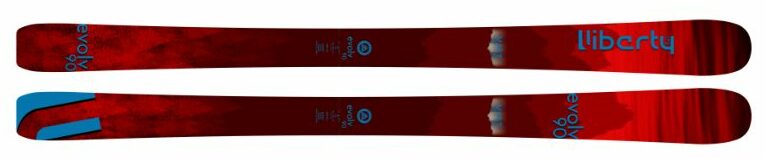
Little Liberty out of Avon, Colorado distinguished itself from scores of other small-batch brands when it made two momentous decisions a few years ago, one commercial, one technical. On the brand-building front, it opted to establish a viable network of specialty shops, despite all the hassle and expense compared to selling direct to the consumer. On the technical, ski-building side of the business, it created a new design that used vertical aluminum struts, in lieu of horizontal sheets of Titanal, to dampen vibration and maintain snow connection.
Vertical Metal Technology was first applied in a dual-strut format to a 3-model V Series for the 18/19 season. For a brand that had built a following for its lightweight, bamboo and carbon cores in fat, freeride dimensions, the slender V skis with their hard-snow, fall-line orientation were a considerable departure.
Leaping forward to this year, VMT is still an important part of the Liberty line, which is more than can be said for the V Series. While the pioneer VMT series had several admirable qualities, the market never embraced Liberty as a carving ski provider. So, the savvy lads who run Liberty applied a 3-strut VMT to the already established all-mountain series, evolv. The new evolv 90 sits in the middle of the 3-model evolv series (the other evolv models are the 84 and 100) where it serves as the centerpiece, literally and figuratively, for the evolv family.
My most perspicacious Dear Readers will note that last year the evolv 90 earned recognition as a Finesse ski, while this year it exhibits the traits of a Power model. Since all that changed between the two iterations was the addition of a third aluminum element, it’s plausible to assume the 21/22 version’s additional accuracy on edge is directly attributable to the power provided by the third strut.
When you put the evolv 90 through its paces, its carving characteristics predominate. In a category chock full of skis with disconnected tips, its VMT struts keep it glued to the hill for nearly every cm of its length. If you look closely at its shape, its sidecut is very similar to that of the Kästle MX88, another AME anachronism that would rather carve than drift.
If the skier presses firmly into the forebody, the evolv 90 can be coaxed into the top of a tight carve, but its trajectory straightens out as soon as it crosses the fall line. The tail is solid and supportive, maintaining snow contact rather than delivering a propulsive lift. The overall platform is very supportive, so the skier can opt to lay the evolv 90 over on a high edge if so inclined.
The bane of all ski manufacturers, large and small, is base and edge finish, but it’s a particularly vexing problem for capital-strapped indie brands. While the evolv 90 has no problem finding the fall line, it could use a little help in the drift department. It doesn’t care much for being smudged downhill, a move that’s a must-have in the havoc of off-trail conditions. The evolv 90 is always going to want to carve when edged, so I see little harm in applying a base pattern that will allow it to slip sideways when the pilot sends the signal to skid.
Another similarity the evolv 90 shares with the MX88 is both need to be driven. You can’t just stand on them and smile contentedly, at least not in the relatively long length (186cm) skied by our crew. They need speed in their veins, which is why they lose patience with short turns until they have some g’s flowing. It’s a powerful ski that strong, technical skiers can appreciate. As John Beesley, Director of the Mt. Rose Ski School, succinctly sketched its profile: “All the skier needs to do to make this ski perform is apply direct pressure to the outside foot.”