
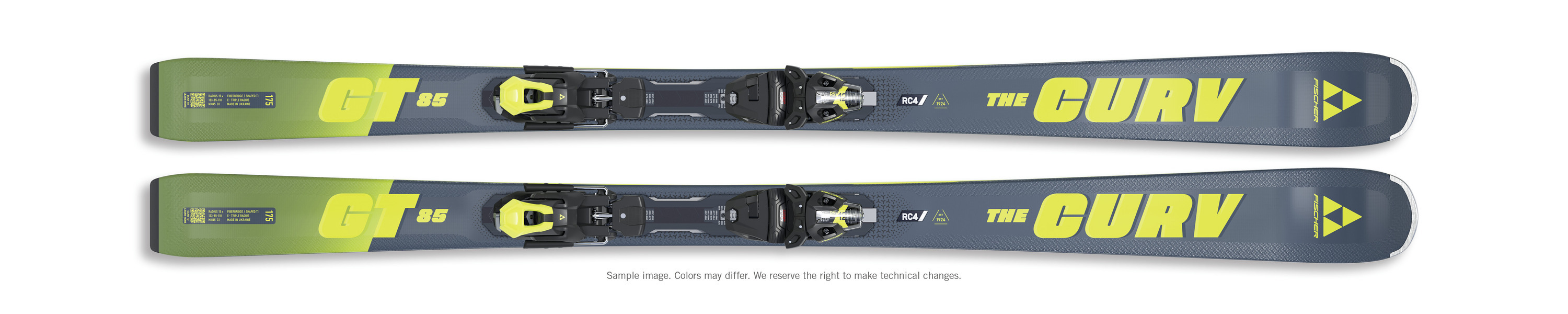




Chances are, the folks at Fischer care more about carving than you do. Like the other major Austrian brands, Fischer is obsessed with World Cup racing, a passion that finds expression in the non-race world in the carving category. While Fischer has had carving skis in its line since going all-in on the shaped-ski craze at its inception, it re-set its commitment to the genre in its 2016/17 product line with the launch of The Curv series. Fischer commissioned three laureled ex-racers – Mike Von Grünigen, Kristian Ghedina and Hans Knauss – to create the ultimate, high-performance carving tool. The first generation of The Curv models deployed undiluted race ski materials and construction, closely aligning the new carving series’ street cred with its racing roots. Some version of The Curv concept has been in Fischer’s collection ever since.
Flash forward to today, and the flagship of the Curv collection is its widest incarnation, a once inconceivable 85mm at the waist. (The original Curvs were all Technical skis, with waists of 68mm, 72mm and 74mm for the flagship, which also sported a thick and beefy plate.) While fans of the older generations of The Curv can still find the venerable 70mm-waisted iteration in the line, the focus of the collection has clearly been shifted to The Curv 85 GT.
The table was set for The Curv 85 GT by its immediate predecessor, the RC One 86 GT, which had a little less shape than the new model (17m vs. 15m @ 175cm), and weighed a bit more, which gave the retiring RC One 86 GT more decisive traction on hard snow. Not that The Curv 85 GT is a weak reed; it still uses two, .8mm-thick slabs of Titanal in its guts, twice the industry norm. But there are cut-outs in the Ti sheets to pare down the weight, a move intended to shift its target playground from rock-hard groomers to something a bit softer. Complementing this shift in emphasis from hard snow to soft is a more compliant flex, so the new model doesn’t have to be driven with race-caliber intensity to be appreciated.
As befits a flagship model, The Curv 85 GT is a showcase for Fischer’s best technology. In addition to the .8mm Titanal laminates, a full sheet of Diagofiber, Fischer’s signature synthetic shock dampener, quiets the ride from tip to tail. The Curv’s distinctive triple radius sidecut (short-long-short) is facilitated by thickening the core underfoot so the addition of edge angle tightens the turn shape automatically. Topping it all off, literally, is a wear-resistant topsheet of Fischer’s own creation.
What all this technology delivers is a ski that reserves its best performances for relatively soft groomers. While it has a waist width (85mm) normally associated with all-terrain aptitude, The Curv 85 GT would rather be carving corduroy than deflecting crud bumps. (Whenever there’s a nearly 50mm drop between tip width and waist, there’s a decided disposition in favor of groomers.) With a softer flex than the RC One 86 GT (and other notable denizens of the carving clique), it’s easier to bow in a lower speed range, so skiers who lack the power to drive a true race ski can still feel the exhilaration of a cleanly carved arc.
In a switch from the industry norm – and Fischer’s own previous practice – the narrower members of The Curv clan have a lower performance range than the 85mm flagship. Hence The Curv GT 80 with its thinner (.5mm) Ti sheets feels less substantial and less accurate on edge despite its more slender footprint. The Curv 85 GT is likely to cost $150 more than The Curv 80 GT at retail; in light of all the lucre one must lay out to be a skier these days, $150 is a pittance. The daily performance benefits of stepping up far outweigh the costs, which will soon be forgotten. If you don’t spend the additional dough, however, you’ll be reminded every time you go skiing that you should have.
Fischer is part of a growing cadre of ski brands willing to directly address the need to improve its sustainability practices. The embodiment of this will to go green at the product level is a version of The Curv 85 GT, the Curv GT Define. Components that have either been re-sourced or eliminated include flax fibers in lieu of carbon or glass; recycled AL4®ever Titanal®, Zero Waste Wood Core and 50% reused materials go into bases and sidewalls. Eliminating the plate interface also wipes out 100% of its environmental impact. Manufacturing the Curv GT Define in Austria, close to Fischer’s raw material sources, reduces shipping distances, which also minimizes the environmental impact of manufacturing. While ski manufacturing is still a long way from being a zero-impact activity, symbolic gestures that demonstrate the feasibility of what we can do today can make a difference in what we’re able to do, collectively, tomorrow.