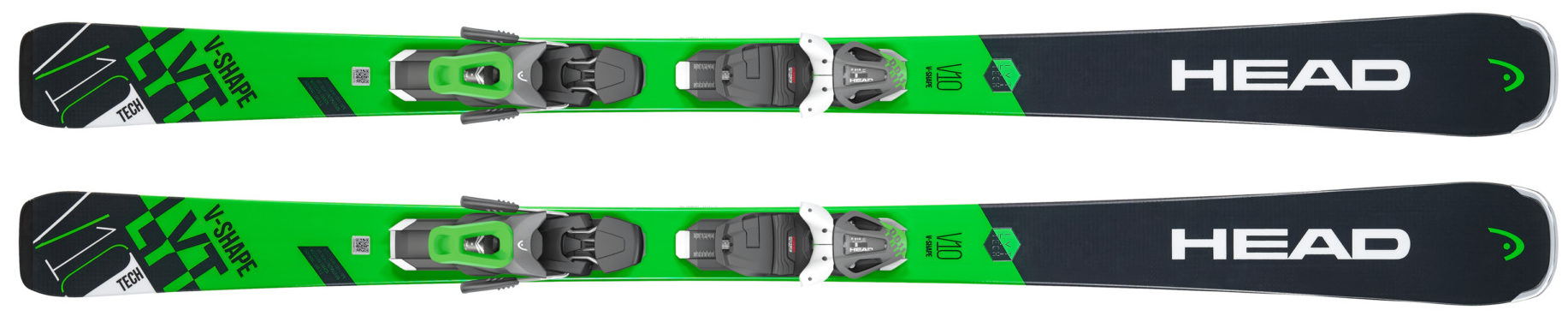
Several stars had to align for Head to concoct the new V-Shape V10. First, Head needed a license to use Graphene, the lightest and strongest material known to man. Second, the world of consumer goods had to shift to an emphasis on lighter weight, inspiring designers – including ski equipment designers – to look for ways to reduce mass everywhere possible. Third, Head needed a way to differentiate its core line of system skis – skis sold with an integrated binding platform – both within its own line and vis-à-vis its competition.
The result of all this cosmic alignment is a series of skis (and matching boots, BTW) with lightweight as a top priority. After stepping off a Monster 88 Ti or Supershape i.Rally, the V-Shape V10 feels like it’s made from gossamer and eider down.
To make a lightweight ski sturdy enough to satisfy an expert skier would require Head to challenge all its assumptions about what makes a ski stable. The most sacred cow to be slaughtered in this design reboot was the assumption that skis are always thickest underfoot and gradually taper towards tip and tail.
By increasing sidewall height at the extremities, Head made the V-Shape V10 softer underfoot. This allows skiers who don’t visit the gym on every off day to bend a high performance carving ski. Complementing the easy-bowing action is a subdued rebound, like a slingshot in slow motion. Agile enough to negotiate most mogul fields, the V-Shape V10 would prefer not to, as it’s forte is continuous carving, as in top to bottom. This all but mandates an even carpet as the skier’s canvas, rather than the rough-and-tumble of off-trail terrain. If you spend half your time off-piste, the V-Shape V10 is probably not your stick.
But if you want what one tester calls a “predictable carver,” look no further. Lighter weight skiers, like the chic Danielle Goldsmith from the shop that bears her name, will find the V-Shape V10 to be “fast, with incredible edge grip. Feels like a GS with an 85mm waist,” she notes.